

DIY Face Masks for Uneven Skin Tone

Table of Contents
- Why DIY Face Masks for Uneven Skin Tone Need More Than Kitchen Scraps
- Natural Remedies for Hyperpigmentation: What Works and What Wastes Your Time
- 5 DIY Face Masks for Uneven Skin Tone You Can Make Tonight
- DIY Face Mask Safety and Patch Testing: Read This Before You Mix Anything
- How Long to Leave a Face Mask On (and What Happens If You Overdo It)
- Matching Ingredients to Your Skin Type: A Compatibility Guide
- After the Mask: Building a Routine That Keeps Results Going
- Frequently Asked Questions
Last Updated: October 3, 2026
Why DIY Face Masks for Uneven Skin Tone Need More Than Kitchen Scraps
DIY face masks for uneven skin tone can fade dark spots and brighten your complexion, but only when you understand what causes the discoloration. Many women mix random kitchen ingredients and wonder why nothing changes.
Most guides hand you a recipe and skip why your skin is uneven, what your skin type can handle, and how to apply a mask without damage.
What Actually Causes Uneven Skin Tone
Uneven skin tone happens when melanin production goes into overdrive in certain spots, creating dark patches known as hyperpigmentation.
The usual triggers:
- Sun damage builds up over years and is the top cause of dark spots
- Inflammation from acne, cuts, or irritation leaves marks behind
- Hormonal shifts can darken patches on the face
Brightening a spot means calming pigment cells and speeding up cell turnover. A mask that only moisturizes won't touch either, the ingredient list matters more than the ritual.
Natural Remedies for Hyperpigmentation: What Works and What Wastes Your Time
Some natural remedies for hyperpigmentation genuinely help; others just smell nice. The difference is whether an ingredient calms inflammation, blocks excess pigment, or gently lifts dead cells.
Ingredients with real backing:
- Turmeric contains curcumin, which fights inflammation and helps fade dark spots
- Papaya offers natural enzymes that dissolve dead skin cells
- Green tea delivers antioxidants that fight free radicals
What wastes your time? Anything that only sits on the surface. Oatmeal and plain yogurt feel lovely but won't fade stubborn spots alone, pair them with proven actives or skip them.
5 DIY Face Masks for Uneven Skin Tone You Can Make Tonight
These five DIY face masks for uneven skin tone use ingredients you likely already have. Each targets a different concern, so pick based on what your skin needs today.
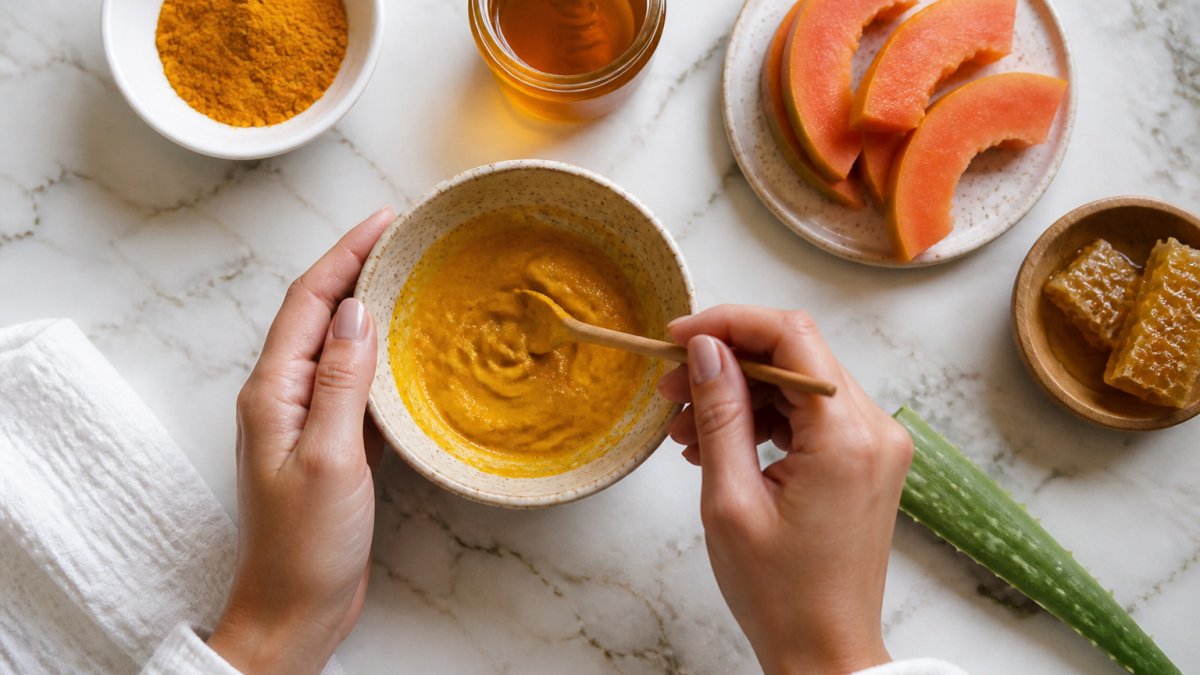
Before mixing, wash your face and gather a small bowl, spoon, and clean towel. Patch test every recipe below.
Papaya and Honey Brightening Mask
Papaya's enzymes gently exfoliate while honey pulls in moisture, brightening without harsh scrubbing.
- Mash two tablespoons of ripe papaya
- Stir in one tablespoon of raw honey
- Add a few drops of lemon juice if your skin isn't sensitive
- Apply an even layer and leave on for 15 minutes
- Rinse with lukewarm water
This one suits most skin types and works well as a weekly treatment.
Turmeric and Yogurt Spot-Treatment Mask
This mask targets dark spots directly: turmeric fades discoloration and yogurt adds gentle lactic acid.
- Mix half a teaspoon of turmeric with two tablespoons of plain yogurt
- Add a teaspoon of honey to bind it
- Dab only on dark spots, not your whole face
- Leave on for 10 to 15 minutes
- Rinse well, since turmeric can stain
For a ready-made option, our Turmeric & Lemon Set pairs turmeric and lemon to fade dark spots, calm breakouts, and even out tone.

Green Tea and Aloe Vera Tone-Correcting Mask
Green tea's antioxidants fight free radicals while aloe vera calms redness and hydrates, soothing while it corrects.
- Steep one green tea bag in hot water, then cool it
- Mix two tablespoons of aloe vera gel with one tablespoon of the cooled tea
- Add a teaspoon of vitamin E oil
- Apply and relax for 15 minutes
- Rinse and follow with moisturizer
This is our pick for sensitive skin and anyone dealing with redness on top of discoloration.
DIY Face Mask Safety and Patch Testing: Read This Before You Mix Anything
DIY face mask safety and patch testing protect your barrier from reactions that worsen uneven tone. A patch test is simple: apply a small amount to your inner arm, wait 24 hours, and check for redness, itching, or swelling.
But a patch test only works if you know what you're testing for. Most reactions fall into three categories:
- Irritant contact dermatitis, a direct chemical burn or stripping of the barrier. Shows up as stinging, tightness, and redness within minutes to hours. Common culprits: undiluted lemon juice (pH around 2), raw garlic, and cinnamon.
- Allergic contact dermatitis, an immune response that can take 24 to 72 hours to appear. Shows up as itching, small bumps, or a rash that spreads beyond where you applied the mask. Common culprits: essential oils (especially citrus and lavender), propolis in raw honey, and fragrances.
- Phototoxic reaction, a burn triggered when certain plant compounds meet UV light. Shows up as a streaky, blistering burn in the shape of where you applied the mask. Common culprits: citrus oils, bergamot, and lime.
That third category is the one most DIY guides skip, and it's why a mask that felt fine at night can leave a mark by the next afternoon.
How to Run a Patch Test That Actually Tells You Something
- Mix the full recipe exactly as written, including every ingredient.
- Clean a one-inch patch on the inside of your forearm with plain soap and water.
- Apply a thin layer and let it dry completely.
- Leave it undisturbed for 24 hours. Don't wash the area.
- Check at 24 hours, then again at 48 hours for allergic reactions.
- If you see redness, bumps, itching, or swelling at either check, do not use the mask on your face.
People often patch test the base ingredient (like yogurt) but skip the active one (like turmeric or lemon), usually the actual trigger. Test the finished mixture, not the components.
Ingredients That Cause the Most DIY Reactions
| Ingredient | Risk | Why |
|---|---|---|
| Undiluted lemon juice | High | pH near 2; strips barrier and causes phytophotodermatitis |
| Cinnamon (powder or oil) | High | Cinnamaldehyde is a known sensitizer |
| Essential oils (citrus, lavender, peppermint) | High | Concentrated allergens; never apply neat |
| Raw honey | Low-moderate | Safe for most, but propolis can trigger allergies |
| Turmeric | Low | Rarely irritates, but stains skin and fabric |
| Yogurt, oatmeal, aloe | Low | Generally well tolerated |
Other Safety Rules Worth Following
- Never leave a mask on longer than the recipe says.
- Dilute essential oils to no more than 1% of the total mixture (about 6 drops per ounce of carrier).
- Don't mix more than three or four active ingredients at once, you can't tell which one caused a reaction.
How Long to Leave a Face Mask On (and What Happens If You Overdo It)
How long to leave a face mask on depends on what's in it, not a universal timer. Each active works through a different mechanism, and each has a window before it stops helping and starts hurting.
Timing by Ingredient Mechanism
Papaya (papain and natural AHAs), Papain is a proteolytic enzyme that breaks down keratin on dead skin cells.
Turmeric (curcumin), Curcumin is an anti-inflammatory polyphenol, not an exfoliant.
Green tea (EGCG and polyphenols), These antioxidants neutralize free radicals on contact.
Yogurt (lactic acid), Lactic acid is an AHA.
Lemon juice, Even diluted, timing matters most here. Citric acid at pH near 2 can burn skin in under 10 minutes.
A Quick Reference
| Ingredient | Mechanism | Ideal Time | Risk Past Window |
|---|---|---|---|
| Papaya | Enzymatic exfoliation | 10-15 min | Barrier stripping, redness |
| Turmeric | Anti-inflammatory | 10-15 min | Staining, warmth on sensitive skin |
| Green tea | Antioxidant | 10-15 min | None; just wasted time |
| Honey / aloe | Humectant | 20-30 min | Reverse osmosis, pulls moisture out |
| Yogurt | Mild AHA | 10-15 min | Mild irritation |
| Lemon (diluted) | AHA + photosensitizer | 5-10 min | Chemical burn, sun sensitivity |
What Happens If You Overdo It
Overdoing a mask causes cumulative problems:
- Enzymatic exfoliation masks left too long strip the barrier, which triggers inflammation, and inflammation is one of the root causes of the uneven tone you're trying to fix.
- Acidic ingredients like lemon can burn if left on past 10 minutes, and the resulting post-inflammatory hyperpigmentation is often darker and harder to fade than the spot you started with.
- Drying masks pull moisture out and trigger rebound oil production, which can lead to clogged pores and new acne marks.
The Rule That Beats Every Timer
Set a timer, but also trust sensation. If a mask starts to sting, itch, or feel tight before the timer goes off, rinse it off. Your skin won't absorb more benefit after the window closes, and the risks climb fast. Two well-timed masks a week will always outperform five masks left on too long.
Matching Ingredients to Your Skin Type: A Compatibility Guide
Not every mask suits every face. This table matches common ingredients to skin types so you can pick with confidence.
| Skin Type | Best Ingredients | Avoid | Why |
|---|---|---|---|
| Oily | Turmeric, green tea, clay | Heavy oils, honey in excess | Controls oil and calms breakouts |
| Dry | Honey, aloe vera, vitamin E oil | Clay, lemon | Adds hydration and supports the barrier |
| Sensitive | Aloe vera, green tea, yogurt | Lemon, strong turmeric | Soothes without triggering reactions |
| Combination | Papaya, yogurt, honey | Undiluted lemon | Balances oil while gently exfoliating |
| Acne-prone | Turmeric, green tea | Heavy butters, coconut oil | Fights inflammation and pore congestion |
After the Mask: Building a Routine That Keeps Results Going
A mask alone won't hold your results, what you do after matters just as much, and most guides skip it.
Follow every mask with:
- A gentle rinse using lukewarm water
- A hydrating toner to restore pH balance
- A moisturizer to lock in moisture
- Sunscreen every morning, no exceptions
That last step protects everything else: without daily sun protection, new dark spots form faster than any mask can fade them.
For a finishing step that supports your routine, our Turmeric & Lemon Body Oil uses curcumin and lemon vitamin C to brighten tone and reduce the look of dark spots on the body, too.

Consistency beats intensity. Two masks a week, done safely, will outpace a daily routine that irritates your skin.
Frequently Asked Questions
Which DIY face mask is best for uneven skin tone?
Masks combining turmeric with a base like yogurt or honey tend to work best for uneven skin tone because curcumin in turmeric helps fade dark spots and calm inflammation. Papaya masks are a strong second option since papaya contains natural enzymes that gently exfoliate dead cells and support a more even complexion. Rotate two or three recipes rather than relying on one, and always patch test first.
How often should I use a DIY face mask for skin discoloration?
Two to three times per week is a reasonable starting point for most skin types. If your skin is sensitive, begin with once a week and build up. Overusing masks, especially ones with lemon juice or strong exfoliants, can compromise your skin barrier and trigger more discoloration rather than less. Give any routine at least four to six weeks before judging results.
Are there natural ingredients that help fade dark spots?
Yes. Turmeric, papaya, aloe vera, green tea, and vitamin E oil all have research supporting their use for dark spots and uneven tone. Turmeric's curcumin reduces inflammation and interferes with excess melanin production. Papaya provides enzymatic exfoliation. Aloe and vitamin E support healing and hydration. None of these replace sun protection, which remains the single most important step for preventing new dark spots.
Do I still need sunscreen if I use natural remedies for hyperpigmentation?
Absolutely. Sun exposure is the leading driver of hyperpigmentation, and UV rays will undo weeks of masking in a single afternoon. Some ingredients, including lemon juice and papaya enzymes, can make skin more photosensitive. Apply a broad-spectrum sunscreen with SPF 30 or higher every morning, even on cloudy days, and reapply every two hours when you're outside.
Uneven skin tone takes patience, and the wrong ingredients can set you back weeks. FAITH & RICH builds handcrafted toners and honey-based skincare that work alongside your DIY routine, targeting blemishes, uneven tone, and signs of aging without harsh additives. Explore our turmeric and lemon sets, handcrafted toners, and honey-based soaps to round out a routine that treats your skin gently. Get started with FAITH & RICH and build a brightening ritual that fits your skin, not someone else's.


