

Royal Jelly Skincare Routine for Beginners

Table of Contents
- What Is Royal Jelly and Why It Works for Skin
- Royal Jelly Skin Benefits You Should Know
- How to Patch Test Skincare Products Before Full Use
- Building Your Royal Jelly Skincare Routine for Beginners
- How to Layer Skincare Products With Royal Jelly
- Storage, Frequency, and Safety Precautions
- Frequently Asked Questions
Last Updated: September 27, 2026
What Is Royal Jelly and Why It Works for Skin
Royal jelly is a nutrient-dense secretion produced by honeybees and the primary food source for queen bee larvae. When applied topically, it delivers amino acids, fatty acids, and antioxidants that strengthen your skin barrier and promote cell regeneration.
Royal jelly contains proteins, vitamins, and minerals that reduce inflammation and address hyperpigmentation, uneven skin tone, and early signs of aging.
At FAITH & RICH, we've built our handcrafted skin toners and honey-based soaps around these powerful bee-derived ingredients. Royal jelly works well for beginners because it's gentle enough for sensitive skin yet potent enough to deliver visible results without harsh chemicals.
Royal Jelly Skin Benefits You Should Know
Hydration and moisture retention: Royal jelly acts as an emollient, sealing water into your skin and preventing dryness, especially valuable for dry climates or dehydrated skin.
Anti-aging support: Amino acids and antioxidants minimize fine lines and support collagen production.
Inflammation reduction: Royal jelly's natural anti-inflammatory action calms irritated skin and fades redness, providing relief for breakouts and sensitivity.
Hyperpigmentation improvement: Bioactive compounds support cell regeneration and fade dark spots.
Skin barrier strengthening: Royal jelly reinforces your skin's protective layer, making it more resilient to environmental stressors.
How to Patch Test Skincare Products Before Full Use
Patch testing is essential before introducing royal jelly, as bee products carry a higher risk of delayed allergic reactions. A 48-hour test prevents reactions and identifies sensitivities before they affect your face.
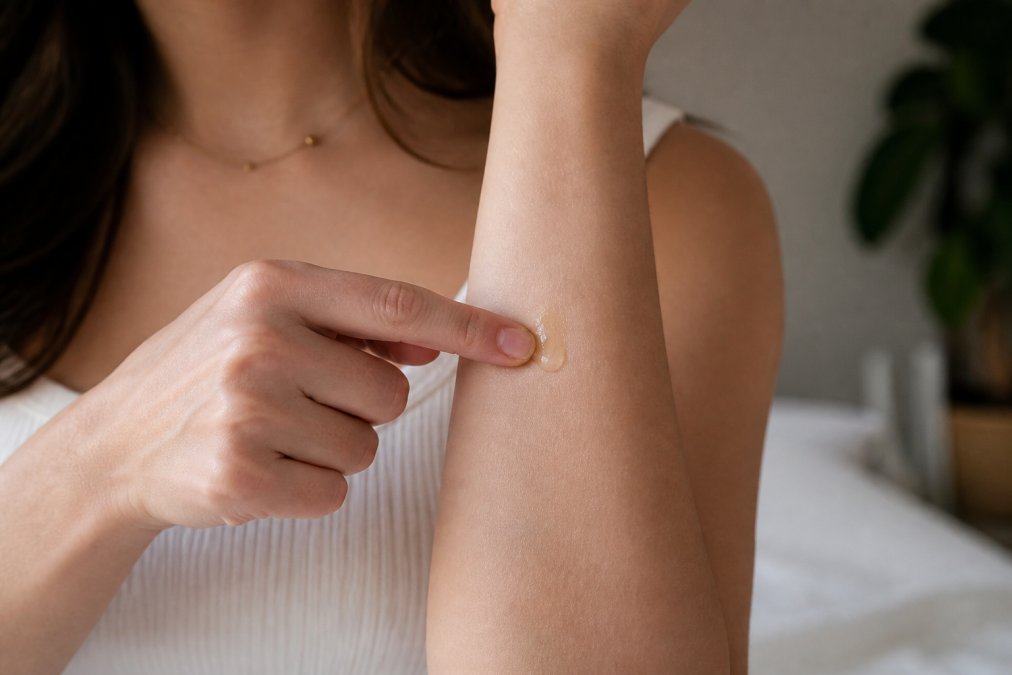
What you need:
- The royal jelly product you're testing
- A clean, small area of skin (inner arm or behind ear)
- Time to observe for 48 hours minimum
- A journal or phone notes to record observations
Step 1: Choose your test area. The inner arm is ideal because the skin is thin and sensitive, similar to facial skin. Clean gently with water and pat dry. Avoid recently shaved or exfoliated areas, which can trigger false positives.
Step 2: Apply a small amount. Use a dime-sized portion, rub gently, and let dry naturally. Don't cover with clothing or wash off immediately.
Step 3: Wait and observe for 48 hours. Watch for redness, itching, burning, swelling, or hives. Immediate reactions (within 2 hours) suggest contact dermatitis; delayed reactions (12-48 hours) suggest allergic sensitization.
Step 4: Assess the results. No reaction after 48 hours means the product is likely safe.
Interpreting ambiguous results:
- Mild warmth or flushing: Normal; wait the full 48 hours.
- Itching resolving within 30 minutes: Likely hydration or penetration, not allergy. Proceed cautiously.
- Persistent itching after 2 hours: Stop immediately; suggests contact irritation or allergic response.
- Hives or swelling: Discontinue; indicates allergic reaction.
Building Your Royal Jelly Skincare Routine for Beginners
A royal jelly skincare routine should start simple and expand gradually, helping you identify which products work for your skin.
Your core routine includes:
- A gentle cleanser
- A royal jelly serum or toner
- A moisturizer
- Sunscreen (daytime only)
Morning Application
Cleanse with lukewarm water and a gentle, pH-balanced cleanser. Pat skin dry gently.
Evening Application
Your evening routine allows products to work overnight, an ideal time for royal jelly treatments.
How to Layer Skincare Products With Royal Jelly
Product order determines absorption and efficacy. Royal jelly works best when layered correctly with complementary ingredients and spaced from incompatible actives.
Proper layering order:
- Cleanser (removes impurities)
- Toner or essence (preps skin)
- Royal jelly serum (delivers active ingredients)
- Lightweight treatments (serums, spot treatments)
- Moisturizer (seals everything in)
- Face oil (optional, for extra hydration)
- Sunscreen (daytime only)
Ingredient compatibility: What works with royal jelly
- Hyaluronic acid: Apply first (thinner), then royal jelly serum for synergistic hydration and plumping.
- Niacinamide: Safe to layer directly; use niacinamide first if in a toner.
- Vitamin C: Apply first, wait 5-10 minutes, then royal jelly to prevent pH interference.
- Peptides: Layer before royal jelly; both are hydrating and compatible.
- Glycerin: Can layer in any order with royal jelly.
Ingredient incompatibilities: What to avoid or space apart
-
Retinol and retinoids: Do not layer with royal jelly on the same night if you have sensitive skin. Use on alternating nights instead. If your skin is resilient, wait 10-15 minutes between applications.
-
AHAs and BHAs: Do not use on the same night as royal jelly if new to either ingredient. Space to different evenings; once accustomed, wait 15-20 minutes between applications.
-
Vitamin A derivatives (retinyl palmitate, retinaldehyde): Milder than prescription retinoids but still increase turnover. Follow the same spacing rule as retinol: alternate nights for sensitive skin, or wait 10-15 minutes between applications if your skin is resilient.
-
Strong oxidizing actives (benzoyl peroxide): Can degrade some of royal jelly's bioactive compounds and increase irritation risk. Use benzoyl peroxide on separate nights from royal jelly, or apply benzoyl peroxide in the morning and royal jelly in the evening.
-
Vitamin E (tocopherol) in high concentrations: May compete with royal jelly's antioxidant action and can feel heavy when layered together. If your moisturizer contains vitamin E, you don't need to add a separate royal jelly product; choose one or the other, or use them on alternating nights.
Wait time between layers:
- After cleanser: 30 seconds (pat skin to damp, not dripping wet)
- After toner or essence: 30-60 seconds
- After royal jelly serum: 1-2 minutes before applying moisturizer
- After lightweight serums: 1-2 minutes
- After moisturizer: 2-3 minutes before sunscreen (daytime) or face oil (evening)
- Between actives (retinol, AHA, vitamin C) and royal jelly: 10-20 minutes if layering on the same night; or use on alternate nights for sensitive skin
Sample routines for common combinations:
Routine A: Royal jelly + vitamin C (brightening focus)
- Cleanser → Wait 30 seconds → Vitamin C serum → Wait 5-10 minutes → Royal jelly serum → Wait 1-2 minutes → Moisturizer → Sunscreen (AM)
Routine B: Royal jelly + retinol (anti-aging focus, sensitive skin)
- Monday/Wednesday/Friday evening: Cleanser → Royal jelly serum → Moisturizer
- Tuesday/Thursday/Saturday evening: Cleanser → Retinol → Moisturizer
- This spacing prevents over-irritation while allowing both actives to work.
Routine C: Royal jelly + niacinamide (barrier support)
- Cleanser → Niacinamide toner → Wait 30 seconds → Royal jelly serum → Wait 1-2 minutes → Moisturizer → Sunscreen (AM)
- These ingredients enhance each other with no wait time needed.
Storage, Frequency, and Safety Precautions
Royal jelly products require proper storage to maintain potency. These bee-derived products are sensitive to heat and light, which can degrade their bioactive compounds.
Storage guidelines:
- Keep products in a cool, dark place away from direct sunlight
- Store in the refrigerator if your bathroom gets warm (above 75°F)
- Tightly seal containers after each use to prevent oxidation
- Check expiration dates before use
Frequency of use:
- Royal jelly serum or toner: twice daily (morning and evening)
- Royal jelly mask: 1-2 times per week
- Royal jelly overnight treatment: 3-5 times per week
Safety precautions:
- Discontinue use immediately if you develop a rash, hives, or difficulty breathing
- If you're allergic to bee products, avoid royal jelly entirely
- Pregnant or nursing women should consult a healthcare provider before use
- Royal jelly may interact with certain medications, check with your doctor if you take blood thinners or immunosuppressants
When to see a dermatologist:
- If irritation persists after discontinuing the product
- If you develop signs of infection
- If your skin condition worsens instead of improves
- If you have questions about using royal jelly with existing skin conditions
Frequently Asked Questions
Is it safe to apply royal jelly directly to my face?
Royal jelly can be applied directly to the face, but always patch test first on your inner arm or behind your ear for 24-48 hours to check for allergic reactions. Because royal jelly contains bioactive compounds and amino acids, some people with sensitive skin or bee allergies may experience irritation. Start with a small amount and introduce it gradually into your routine. If you have a known bee allergy, consult a dermatologist before use.
What are the main royal jelly skin benefits?
Royal jelly delivers multiple skin benefits: it supports collagen production and cell regeneration, reduces inflammation, provides hydration through its emollient properties, and offers antioxidant protection against environmental damage. The fatty acids and amino acids in royal jelly strengthen your skin barrier and improve moisture retention, while its bioactive compounds help reduce the appearance of fine lines and uneven skin texture.
How do I know if royal jelly is right for my sensitive skin?
Patch testing is essential for sensitive skin. Apply a small amount to your inner arm and wait 24-48 hours before using it on your face. Watch for redness, itching, or burning. If you have a history of reactions to bee products or pollen, start with a lower concentration or use royal jelly in a rinse-off mask format first rather than leave-on products. Consider layering royal jelly with a calming, hydrating serum to buffer potential irritation.
Should I use royal jelly in the morning or at night?
Both work, depending on your skin goals and routine. Morning application pairs well with sunscreen and provides antioxidant protection throughout the day. Evening use, especially as an overnight treatment or in a richer cream formulation, allows the bioactive compounds to support cell regeneration during sleep. Many beginners find evening application easier because royal jelly can feel slightly occlusive and may not layer well under makeup. Start with evening use, then experiment with morning application once your skin adjusts.


