

Propolis Skincare for Redness and Inflammation

Table of Contents
- What Is Propolis and Why It Works for Redness
- Benefits of Propolis for Sensitive Skin
- How to Use Propolis Serum for Redness
- Propolis Side Effects on Face and Patch Testing
- Propolis vs. Other Bee-Derived Ingredients
- Choosing Propolis Skincare: Formulation and Sourcing
- Frequently Asked Questions
Last Updated: September 16, 2026
What Is Propolis and Why It Works for Redness
Propolis is a resinous substance that honeybees produce by combining plant sap, beeswax, and their own enzymes to seal and protect the hive. In skincare, propolis skincare for redness and inflammation has become a go-to for people whose skin reacts to everything else.
Here's the catch most guides skip: propolis is not a single ingredient. Its color, texture, and bioactive content shift depending on what plants the bees visited and what season it was. That variability is exactly why formulation and sourcing matter as much as the ingredient itself.
The Science Behind Propolis and Skin Inflammation
Propolis contains flavonoids, phenolic compounds, and other bioactive compounds that give it antioxidant and antibacterial properties (pubmed.ncbi.nlm.nih.gov). These aren't marketing buzzwords. They describe how the substance interacts with skin at a cellular level.
The practical takeaway: these compounds appear to calm the visible signs of irritation while supporting the skin's own repair processes. Many formulators combine propolis with ingredients that reinforce barrier function, because a compromised barrier is usually the root cause of persistent redness.
What most guides miss is that concentration matters less than delivery. A well-formulated product with moderate propolis content often outperforms a heavily loaded one that irritates sensitive skin on contact.
Benefits of Propolis for Sensitive Skin
The benefits of propolis for sensitive skin come down to three things: calming visible irritation, supporting the skin barrier, and helping skin hold onto moisture.
People with sensitive skin often cycle through products that promise soothing relief and deliver stinging instead. Propolis tends to be gentler because it works with the skin rather than stripping it. Its antioxidant content also helps defend against everyday environmental stress that can trigger flare-ups.
One honest limitation: propolis is not a treatment for rosacea, eczema, or any diagnosed skin condition. It's a supportive ingredient, not a prescription. If your skin is actively inflamed or broken, see a dermatologist before layering anything new on top.
Redness Reduction and Barrier Support
Redness reduction and barrier support are two sides of the same coin. When the skin barrier is intact, irritants stay out and moisture stays in. When it's compromised, everything stings and redness lingers.
Propolis supports this system in a few ways:
- Antioxidants help neutralize free radicals that aggravate visible redness
- Antibacterial activity may help keep breakout-prone skin in balance
- Soothing properties make it easier to tolerate alongside other active ingredients
A common mistake is treating redness with more actives. That usually backfires. Calming the barrier first, then reintroducing actives slowly, works far more reliably.
How to Use Propolis Serum for Redness
Learning how to use propolis serum for redness is simpler than most people expect. Apply two to three drops to clean, slightly damp skin, press gently into the face and neck, then follow with moisturizer to seal it in.
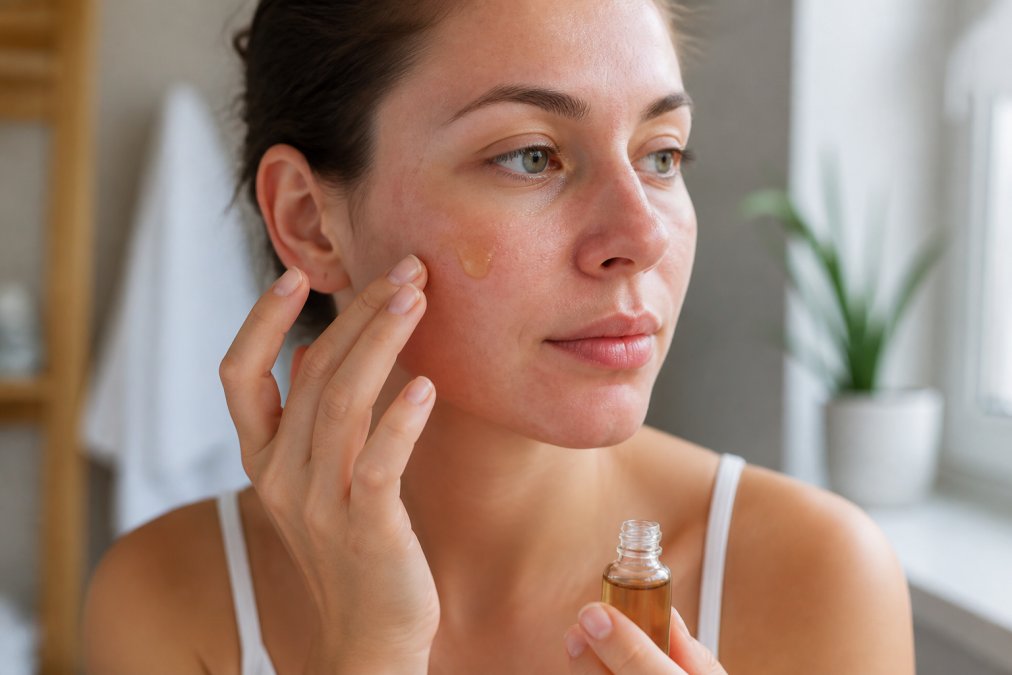
Timing matters more than technique. Use it morning and evening, or evening only if your skin is reactive. Damp skin absorbs water-based serums more evenly, so don't wait until your face is bone dry.
Layering and Synergistic Ingredients
Propolis plays well with others, but order matters. Apply thinnest to thickest: toner, then propolis serum, then moisturizer, then sunscreen in the morning. The reason is simple physics: water-based formulas need to sit closest to the skin to absorb, and occlusive layers on top would block them.
- Centella asiatica (cica), Contains madecassoside and asiaticoside, compounds studied for their ability to calm visible irritation and support the skin's own repair signaling. It complements propolis because cica targets the inflammatory response while propolis targets oxidative stress. A common pairing ratio in K-beauty and clinical-style formulas is roughly equal parts cica extract to propolis extract.
- Panthenol (provitamin B5), Converts to pantothenic acid in the skin and acts as a humectant while supporting barrier repair. It's one of the few soothing ingredients well tolerated by almost everyone, which makes it a smart buffer when you're introducing propolis for the first time.
- Niacinamide, Supports sebum regulation and visible redness reduction at concentrations between 2% and 5%. Above 5%, some sensitive users report flushing, so start low. Niacinamide and propolis are complementary because one works on oil balance and the other on antioxidant defense.
- Hyaluronic acid, Draws water into the upper layers of skin. It doesn't reduce redness directly, but hydrated skin is less likely to react to everything else you layer on top.
- Ceramides, Lipid molecules that make up a significant portion of the skin barrier. If your redness stems from a compromised barrier, ceramides plus propolis is one of the most reliable combinations because you're rebuilding the wall while calming the inflammation behind it.
Propolis Side Effects on Face and Patch Testing
A patch test protocol that actually works:
- Apply a small amount behind your ear or on your inner forearm
- Leave it undisturbed for 24 hours
- Check for redness, swelling, or itching at the 24-hour mark
- Reapply and wait another 24 hours to catch delayed reactions
- Only then introduce it to your face, starting with every other day
If you're already using prescription treatments for a diagnosed condition, ask your dermatologist before adding propolis to the mix.
Propolis vs. Other Bee-Derived Ingredients
Propolis is the calming, antioxidant-rich option among bee-derived ingredients. Honey is primarily a humectant that draws water into the skin. Royal jelly leans toward nourishment and texture support. Beeswax sits on the surface as an occlusive that locks moisture in.
| Ingredient | Primary Role | Best For | Texture |
|---|---|---|---|
| Propolis | Antioxidant, antibacterial, soothing | Redness, irritation, breakout-prone skin | Light serum or extract |
| Honey | Humectant, draws in moisture | Dry, dehydrated skin | Thick, sticky |
| Royal jelly | Nourishing, texture support | Mature or dull skin | Cream or serum |
| Beeswax | Occlusive, seals moisture | Very dry or chapped skin | Solid, waxy |
Choosing Propolis Skincare: Formulation and Sourcing
Formulation type decides how propolis behaves on your skin, and the difference between formats is bigger than most guides admit. Here's how the main options compare for redness and inflammation:
- Serums and ampoules, Highest concentration of propolis extract relative to other ingredients, usually water- or glycerin-based. Fastest absorption, lightest feel. Best for layering under moisturizer and for users who want to control the dose. The trade-off: less buffering, so reactive skin may find them more stimulating than a cream.
- Creams and balms, Propolis is suspended in emollients and occlusives, which slows absorption and reduces the chance of irritation. Ideal for compromised barriers and for nighttime use. The trade-off: heavier texture and lower effective propolis concentration per application.
- Toners and essences, Lowest propolis concentration, designed as a first hydrating layer. Useful for people who want a gentle introduction or who react to richer formats. The trade-off: you may need multiple layers to see meaningful benefit.
- Masks and spot treatments, Short-contact formats with higher concentrations. Good for targeted flare-ups, less suited to daily maintenance because the higher dose increases irritation risk on sensitive skin.
Why Sourcing and Sustainability Matter More Than You Think
Because propolis varies by region, season, and plant source, two products with identical ingredient lists can perform differently. Reputable makers disclose where their propolis comes from, how it's extracted (ethanol, water, or glycerin), and what the standardized flavonoid content is. If a brand can't answer those questions, that's a signal.
What responsible sourcing looks like in practice:
- Harvesting only surplus propolis, leaving enough for the colony's own needs
- Timing collection to avoid peak hive-stress periods
- Working with beekeepers who prioritize colony health over yield
- Third-party testing for heavy metals and pesticide residue, since propolis concentrates environmental contaminants from the plants bees visit
Frequently Asked Questions
Does propolis reduce inflammation?
Propolis contains flavonoids and phenolic compounds that research links to anti-inflammatory activity. In topical propolis skincare, these compounds may help calm redness, swelling, and irritation while supporting the skin barrier. It is not a prescription treatment, so results vary by skin type and formulation. For persistent inflammation, see a dermatologist.
Can propolis help with rosacea and eczema?
Some small studies suggest propolis may soothe rosacea-related redness and eczema irritation thanks to its anti-inflammatory and antibacterial properties. However, evidence is limited and not a substitute for medical care. If you have rosacea or eczema, patch test first and ask your dermatologist before adding propolis skincare to your routine.
How long does it take for propolis to soothe skin redness?
Many users notice a calming effect within a few days of consistent use, while visible redness reduction often takes two to four weeks. Results depend on concentration, formulation, and your skin's sensitivity. Track changes with photos and introduce one propolis product at a time so you can tell what is working.
Is propolis safe for all skin types?
Propolis is generally well tolerated, but it is a bee-derived ingredient, so people with allergies to bees, honey, or royal jelly should be cautious. Do a 24 to 48 hour patch test on your inner forearm before applying to your face. If you have very sensitive skin, start with a low concentration and use it every other day.
Redness and inflammation are stubborn, and no single ingredient erases years of sensitivity overnight. What works is a consistent, gentle routine built around ingredients your barrier can tolerate. FAITH & RICH offers handcrafted skin toners and honey-based soaps designed to calm, nourish, and support your skin without harsh additives. Explore the FAITH & RICH collection and build a routine that treats sensitivity as something to work with, not fight against.


