

Natural Dark Spot Corrector vs Serum: Key Differences

Table of Contents
- What Is a Dark Spot Corrector vs a Serum?
- Best Natural Ingredients for Dark Spots
- How to Treat Hyperpigmentation Naturally at Home
- How Long Does It Take for a Dark Spot Corrector to Work?
- Mixing Correctors and Serums: Active Ingredient Interactions
- Skin Tone Matters: Choosing the Right Approach for Your Complexion
- Cost-Per-Use: What You Actually Pay for Results
- Frequently Asked Questions
Last Updated: September 17, 2026
What Is a Dark Spot Corrector vs a Serum?
A dark spot corrector is a targeted treatment built to fade existing patches of excess pigment, while a serum is a broader, lighter formula designed to treat the skin overall. At FAITH & RICH, we hear this question constantly: do you actually need both? The honest answer is that they overlap more than the labels suggest. A dark spot corrector usually carries a higher concentration of brightening actives and goes directly onto the mark.
How Each Formula Works on Melanin Production
Both formulas aim at the same target: melanin production. Skin darkens when melanocytes overproduce pigment after sun exposure, inflammation, or hormonal shifts. Correctors typically stack several pigment-focused actives to interrupt that process. Serums often pair one brightening ingredient with hydrators and barrier support, so results build more slowly but across a wider area.
Texture, Absorption Rate, and Skin Barrier Impact
Texture decides where each product belongs in your routine. Correctors tend to be thicker, sometimes tacky, and sit on the spot. Serums are fluid and absorb fast, which makes them easy to layer. The trade-off is real: concentrated correctors can irritate a compromised skin barrier, while a lightweight serum rarely does. If your skin is reactive, start with the gentler option and add a targeted treatment later.
Best Natural Ingredients for Dark Spots
The best natural ingredients for dark spots are the ones with a plausible mechanism, a tolerable concentration, and a low irritation risk. Turmeric, vitamin C, niacinamide, azelaic acid, and tranexamic acid all fit that description. What separates them is how they behave on your skin type and where in the pigment pathway they act, not which one sounds most exotic.
How Each Active Interrupts Melanin Production
Pigment forms in a sequence: a trigger (UV, inflammation, hormones) activates the enzyme tyrosinase inside melanocytes, those cells manufacture melanin, and the pigment is transferred to surrounding skin cells. A brightening ingredient is only useful if it interrupts one of those steps.
- Vitamin C (L-ascorbic acid and its derivatives) is an antioxidant that interferes with tyrosinase activity and helps neutralize the oxidative stress that drives pigment formation. It is also unstable, light and air degrade it, which is why packaging and formulation matter as much as the percentage on the label.
- Niacinamide works further downstream by limiting the transfer of melanin from melanocytes to skin cells. It also supports the barrier, which is why it is one of the easiest actives to tolerate at 4-5%.
- Azelaic acid inhibits tyrosinase and has mild exfoliating and anti-inflammatory action, which makes it a common choice for post-acne marks where inflammation is part of the problem.
- Tranexamic acid targets the inflammation-signaling pathway that drives melasma and stubborn pigmentation, rather than tyrosinase directly, a different mechanism than vitamin C or azelaic acid.
- Turmeric (curcumin) is an antioxidant with anti-inflammatory properties. It is a supporting ingredient, not a tyrosinase inhibitor, so it works best alongside one of the actives above rather than as a solo treatment.
Turmeric, Lemon, and Vitamin C: What the Research Shows
Turmeric draws attention for its antioxidant content and its long folk history in brightening routines. Lemon is popular because it contains vitamin C, but it is also acidic, and applying it undiluted is a common mistake that leaves skin raw and more prone to post-inflammatory marks. Vitamin C itself is well established for supporting radiance and evening skin tone. The form and concentration matter far more than the fruit on the label, a stabilized derivative in a properly packaged formula will outperform a fresh-squeezed lemon every time.
Niacinamide, Azelaic Acid, and Tranexamic Acid in Natural Formulas
Niacinamide supports the skin barrier while it helps with discoloration, which makes it one of the easiest actives to tolerate. Azelaic acid is often recommended for stubborn spots and post-acne marks. Tranexamic acid has become a fixture in brightening formulas aimed at melasma and lingering pigmentation. A formula that combines two or three of these at modest levels usually beats one hero ingredient at a harsh dose, because you are hitting more than one step in the pigment pathway at once.
Tranexamic Acid vs. Niacinamide: Which to Choose
These two are frequently confused because both appear in "brightening" serums, but they do different jobs.
| Active | Primary Mechanism | Best For | Typical Range |
|---|---|---|---|
| Tranexamic acid | Reduces inflammation-driven pigment signaling | Melasma, stubborn hormonal patches | 2-5% |
| Niacinamide | Blocks melanin transfer to skin cells | Overall tone, barrier support, oily skin | 4-5% |
How to Treat Hyperpigmentation Naturally at Home
Treating hyperpigmentation at home comes down to four habits: sunscreen every morning, one targeted brightening product, gentle exfoliation, and patience. Skip the sunscreen and nothing else you do will hold.
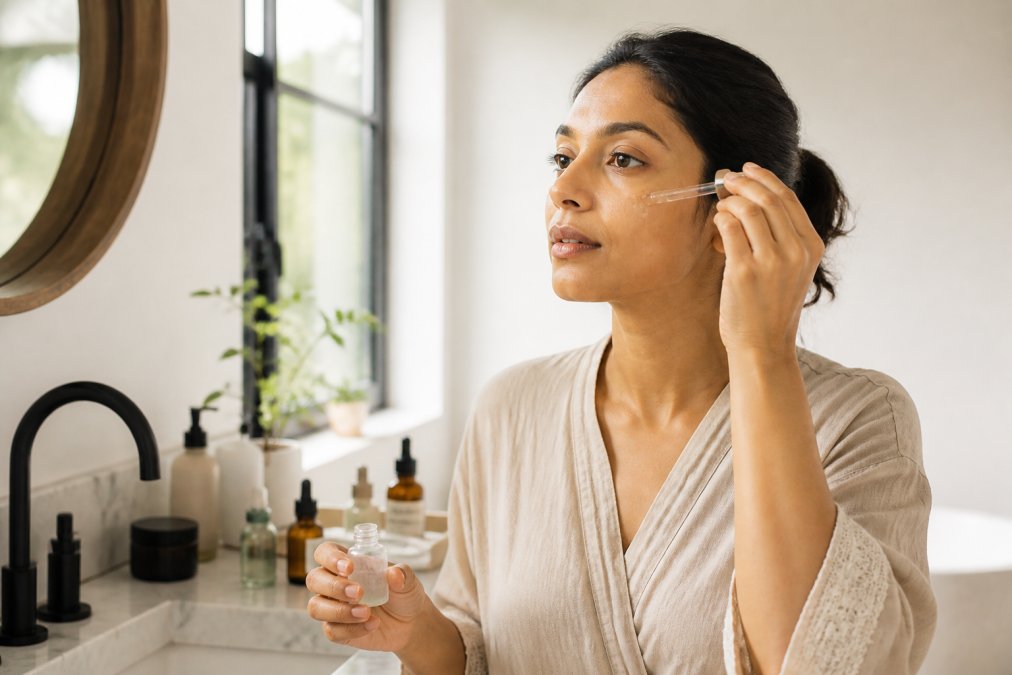
A workable routine looks like this:
- Morning: gentle cleanser, vitamin C or niacinamide serum, moisturizer, broad-spectrum SPF 30 or higher
- Evening: cleanser, targeted dark spot corrector on the marks, moisturizer
- Two or three nights a week: swap the corrector for a mild exfoliant to support cell turnover
- Always: introduce one new active at a time, two weeks apart
How Long Does It Take for a Dark Spot Corrector to Work?
Most people see the first visible change in four to eight weeks, with meaningful fading at three to six months. That timeline is set by cell turnover, not by the product's price. Darker, older spots and post-acne marks take longer than recent sun damage.
Three things slow the process down:
- Skipping SPF. New sun exposure re-darkens the exact spot you are treating.
- Switching products every two weeks. No formula gets a fair trial that way.
- Over-exfoliating. A damaged skin barrier heals with more pigment, not less.
Mixing Correctors and Serums: Active Ingredient Interactions
Layering a dark spot corrector with a serum works, but only if you respect how the actives interact. The safest pattern is one brightening active in the morning and a different one at night. Niacinamide plays well with nearly everything, including vitamin C, despite the old warning that the two cancel each other out. Retinoids and strong acids are the pairing to watch: both increase irritation, and irritation in darker skin tones frequently heals as more pigment.
| Combination | Verdict | Why |
|---|---|---|
| Vitamin C + niacinamide | Safe | Complementary; no meaningful conflict |
| Vitamin C + azelaic acid | Use with care | Both can sting on sensitive skin |
| Retinoid + exfoliating acid | Avoid same night | Compounding irritation, rebound pigment |
| Tranexamic acid + niacinamide | Safe | Common pairing in brightening formulas |
| Correcter + hydrating serum | Safe | Buffer the active, reduce dryness |
Skin Tone Matters: Choosing the Right Approach for Your Complexion
Skin tone changes which approach works best, and it also changes what kind of spot you are actually looking at. Before you buy anything, identify the mark. Two spots that look similar in a mirror need opposite treatments.
First, Diagnose the Spot: PIH vs. PIE
Post-inflammatory hyperpigmentation (PIH) is brown. It happens when inflammation triggers excess melanin, and it is the type most common in medium and deep skin tones. Post-inflammatory erythema (PIE) is red or pink. It comes from dilated blood vessels and damaged capillaries after acne, and it is more visible on fair skin.
The distinction matters because the treatments diverge:
- PIH (brown) responds to tyrosinase inhibitors and melanin-transfer blockers, vitamin C, azelaic acid, niacinamide, tranexamic acid.
- PIE (red) does not respond to brightening actives at all. It needs time, barrier repair, and ingredients that calm vascular inflammation, such as niacinamide and azelaic acid used for their anti-inflammatory action rather than their pigment action.
How Melanin-Rich Skin Reacts Differently
Deeper complexions are more prone to post-inflammatory hyperpigmentation, so anything that inflames the skin carries a pigment penalty (pubmed.ncbi.nlm.nih.gov). That means gentler exfoliation, fewer simultaneous actives, and a lower tolerance for "push through the sting" advice. Ingredients that bleach or aggressively peel, high-percentage hydroquinone without supervision, strong glycolic peels, undiluted lemon, are riskier on melanin-rich skin because the irritation they cause can heal as a new dark mark.
Matching the Approach to Your Tone
| Skin Tone | Most Common Spot Type | Safer Actives | Use Caution With |
|---|---|---|---|
| Fair | Sun-driven PIH, PIE | Vitamin C, niacinamide, mild AHAs | Over-exfoliation |
| Medium | Mixed PIH, sun spots | Niacinamide, azelaic acid, tranexamic acid | Stacking multiple acids |
| Deep | PIH, melasma | Tranexamic acid, niacinamide, azelaic acid | Strong peels, harsh bleaching agents |
If you want a routine built around brightening without harsh actives, the Turmeric & Lemon Set pairs turmeric and lemon in a format designed for daily use.

Cost-Per-Use: What You Actually Pay for Results
Cost-per-use tells you more than the sticker price. A $60 serum you use twice a week for six months costs less per application than a $20 product you abandon after three weeks. Divide the price by the number of applications you will realistically get, then ask whether the formula has the actives to justify it.
| Product | Price | Format | Best For |
|---|---|---|---|
| Turmeric Serum | $19.99 | Single serum | First brightening step, oily skin |
| Collagen & Snail Essence Face Serum | $24.99 | 50ml serum | Hydration plus a healthy glow, AM and PM |
| Turmeric lemon Set | $34.99 | Face cream, body cream, soap | Full-body brightening on a budget |
| Turmeric & Lemon Set | $79.99 | Multi-piece set | Building a complete routine at once |
| Turmeric & Lemon 6 Piece Skin Care Set | $89.99 | Six-piece set | Long-term routine, lowest cost per item |
Frequently Asked Questions
What is the difference between a dark spot corrector and a brightening serum?
A dark spot corrector is a targeted treatment applied directly to individual spots, often with higher concentrations of active ingredients like turmeric or vitamin C. A brightening serum covers the full face to even overall skin tone and improve radiance. Correctors address stubborn spots; serums handle widespread discoloration and post-acne marks. Many routines use both, layering the corrector on spots and the serum everywhere else.

Can you use a dark spot corrector and a serum at the same time?
Yes, but order and timing matter. Apply your serum first on clean skin, let it absorb for one to two minutes, then dab the corrector only on dark spots. Avoid combining multiple exfoliating acids in one session, since that can compromise your skin barrier and cause irritation. A gentle turmeric-based serum paired with a spot corrector works well for most skin tones without overloading the skin.
What are the most effective natural ingredients for fading dark spots?
Turmeric, lemon, vitamin C, niacinamide, azelaic acid, and tranexamic acid all have evidence supporting their use for hyperpigmentation. Turmeric reduces inflammation and supports cell turnover, while lemon is rich in vitamin C and naturally lightens hyperpigmentation. Niacinamide and azelaic acid help regulate melanin production. A product like the Turmeric & Lemon Set combines turmeric and lemon to fade dark spots, brighten skin tone, and gently exfoliate dead skin cells.
How long does it take for natural dark spot treatments to show results?
Most natural dark spot correctors need eight to twelve weeks of consistent use before visible fading appears. Skin cell turnover cycles average around 28 days, so several cycles must pass for pigment to lift. Sun damage and melasma often take longer than post-acne marks. Daily SPF protection is essential because unprotected sun exposure reverses progress and deepens existing spots, no matter how effective your corrector is.
Do I need a spot treatment or an all-over serum for hyperpigmentation?
It depends on how widespread your discoloration is. If you have a few isolated dark spots or post-acne marks, a targeted corrector is more efficient and cost-effective. If discoloration covers larger areas, melasma patches, or your overall skin tone looks uneven, an all-over brightening serum delivers more consistent results. Many people with mixed concerns use a full-face serum daily and spot-treat the most stubborn areas with a concentrated corrector.
Fading dark spots is slow work, and the products that promise overnight results are the ones most likely to leave your skin irritated and more pigmented than before. FAITH & RICH builds handcrafted, honey-based skincare and turmeric and lemon formulas for women who want brightening without the harshness, from a single serum to a complete six-piece routine. Explore the collection and start with the step your skin actually needs.


