

How to Prevent Hyperpigmentation After Acne

Table of Contents
- Why Acne Leaves Dark Spots Behind
- The Golden Rule: Hands Off Your Skin
- Best Skincare Ingredients for Hyperpigmentation
- Why Sunscreen for Acne-Prone Skin Is Non-Negotiable
- How to Fade Dark Spots from Acne You Already Have
- Daily Routine to Prevent Hyperpigmentation After Acne
- When to See a Dermatologist
- Conclusion: Your Clear Skin Journey Starts Now
- Frequently Asked Questions
Last Updated: September 6, 2026
Why Acne Leaves Dark Spots Behind
Post-inflammatory hyperpigmentation (PIH) is the medical term for the dark spots that linger after an acne lesion heals. When your skin experiences inflammation from a breakout, your melanocytes (the cells that produce pigment) go into overdrive, depositing excess melanin in the affected area. The result is a flat, discolored mark that can linger for weeks or even months after the original pimple has cleared.
Understanding this process is the first step in learning how to prevent hyperpigmentation after acne. The key distinction: acne scars are textural changes (pitted or raised), while hyperpigmentation is purely a color change in the skin. This matters because the prevention strategies differ significantly. Calming inflammation early is a key way to stop dark spots from forming in the first place.
The good news is that PIH is treatable and preventable. Unlike true scarring, which requires professional intervention, pigmentary changes respond well to consistent, targeted skincare. Below, we'll walk you through the exact routine and habits that minimize your risk of developing dark spots after every breakout.
The Golden Rule: Hands Off Your Skin
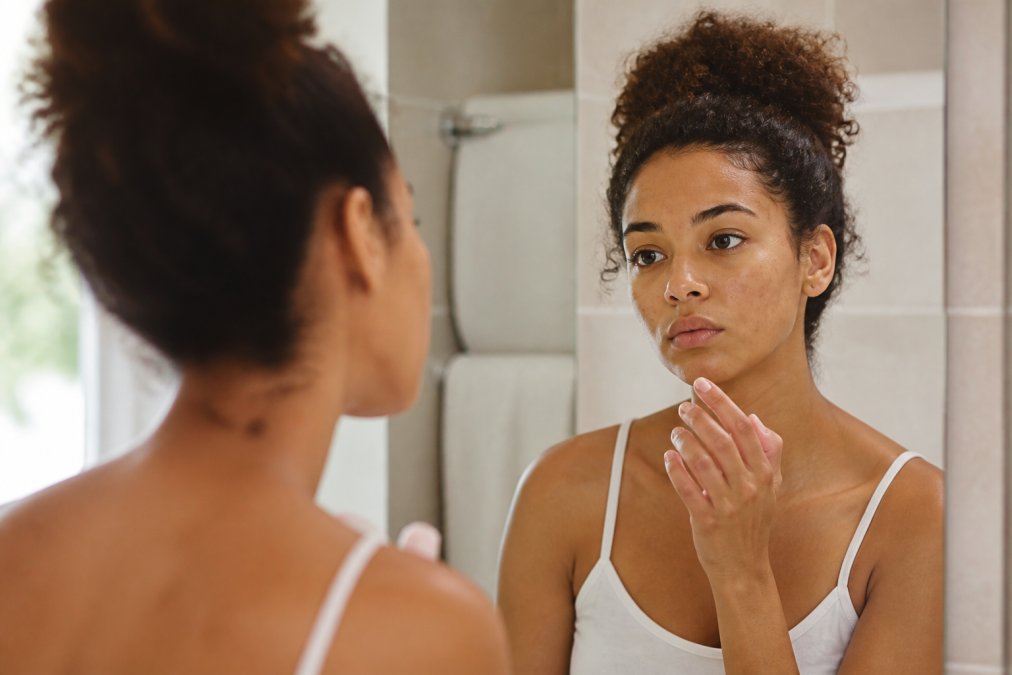
The most common mistake people make is picking, popping, or squeezing their pimples. Every time you manipulate an active acne lesion, you increase inflammation and trauma to the skin, which directly signals your melanocytes to produce more pigment. Picking is the fastest way to turn a temporary breakout into a months-long dark spot.
The same logic applies to aggressive scrubbing. Physical exfoliation on active breakouts creates micro-tears in the skin barrier, triggering more inflammation. Instead of scrubbing, let your skincare ingredients do the work.
Best Skincare Ingredients for Hyperpigmentation
When it comes to active ingredients, you want components that either block melanin production, interrupt pigment transfer, or speed up cell turnover. But not all formulations are equal, and the concentration matters as much as the ingredient itself. Here is what the evidence and dermatologic practice actually support:
-
Niacinamide (2%-5%): A form of vitamin B3 that blocks the transfer of melanosomes (pigment packets) from melanocytes to keratinocytes. At 2%, it is well-tolerated even on sensitive, acne-prone skin. At 5%, it adds a sebum-regulating effect, which is why it appears in many acne-focused moisturizers (PubMed). It is also one of the few ingredients that pairs safely with virtually everything else in your routine.
-
Vitamin C (L-ascorbic acid, 10%-20%): A potent antioxidant that inhibits the enzyme tyrosinase, which catalyzes the first step of melanin synthesis. The catch: L-ascorbic acid is unstable and degrades rapidly when exposed to light and air. Look for opaque, air-tight packaging and formulations that pair it with ferulic acid and vitamin E, which stabilize it and roughly double its photoprotective effect. If your skin stings at 15%, a 10% formulation or a derivative like magnesium ascorbyl phosphate is a gentler entry point.
-
Retinoids (adapalene 0.1% OTC, or prescription tretinoin): These speed up cellular turnover, pushing pigmented cells to the surface faster so they shed. Adapalene is the only retinoid available over the counter in the United States and is uniquely suited for acne-prone skin because it is more selective for retinoid receptors involved in comedolysis, meaning less irritation than tretinoin at comparable efficacy for breakouts (the FDA). Prescription tretinoin (0.025%-0.05%) remains the gold standard for PIH, but it requires a slow ramp-up: start twice weekly for two weeks, then every other night for two weeks, before nightly use if tolerated.
-
Alpha hydroxy acids (AHAs, glycolic 5%-10%, lactic 5%-10%): These gently exfoliate the outermost layer of the epidermis, revealing fresher skin beneath. Glycolic acid is the smallest AHA molecule, so it penetrates deepest and is most effective for pigment, but it is also the most irritating. Lactic acid is larger, gentler, and doubles as a humectant. A leave-on 5%-10% formulation used two to three nights per week is the standard starting point.
-
Azelaic acid (10%-15%): Often overlooked in general guides, azelaic acid is a dicarboxylic acid that inhibits tyrosinase and is anti-inflammatory. It is uniquely suited for acne-related PIH because it treats the active breakouts and the pigment simultaneously, and it is one of the few ingredients considered safe during pregnancy. A 10% OTC formulation or a 15% prescription gel is a strong alternative if retinoids irritate you.
What most guides miss is that layering these incorrectly can backfire. Using a retinoid and an AHA on the same night often causes severe irritation, which paradoxically worsens hyperpigmentation by triggering more inflammation. A common approach is to alternate nights: retinoid one evening, AHA the next. Niacinamide, however, can be used nightly alongside either, and vitamin C belongs in the morning, not the evening, to maximize its antioxidant photoprotection.
Why Sunscreen for Acne-Prone Skin Is Non-Negotiable
Here is the part most people get wrong: sunscreen is not optional if you want to prevent hyperpigmentation after acne. UV exposure directly stimulates melanocytes to produce more pigment, and it darkens any existing dark spots you already have (the NIH). Without protection, every other product in your routine is working against the sun.
Sunscreen for acne-prone skin must be broad-spectrum, meaning it protects against both UVA and UVB rays, with an SPF of at least 30. Look for formulas labeled noncomedogenic so they won't clog pores. Many people skip sunscreen because they fear breakouts, but modern lightweight, oil-free formulations have solved this problem.
Apply a generous layer every morning as the final step of your routine, even on cloudy days. Reapply every two hours if you are outdoors. Indoors, near windows, UVA rays still reach your skin, so daily application is non-negotiable year-round.
FAITH & RICH offers a sunscreen priced at $9.99, making daily protection an easy habit to adopt.

How to Fade Dark Spots from Acne You Already Have
If you already have dark spots, don't panic. The skin is capable of repairing itself, but you need to be consistent. Here is a step-by-step approach to fade existing marks:
- Commit to daily sunscreen. Without this step, fading is nearly impossible.
- Incorporate a vitamin C serum in the morning to brighten and inhibit melanin production.
- Use a retinoid at night to accelerate cell turnover and shed pigmented cells.
- Add a gentle AHA exfoliant once or twice a week to smooth texture and lift surface pigment.
- Be patient. Visible results typically take 8 to 12 weeks of consistent use.
The turmeric-based products from FAITH & RICH are formulated specifically for this purpose. Turmeric contains curcumin, a compound known for its anti-inflammatory properties, which helps calm the skin and reduce the triggers that lead to hyperpigmentation. The Turmeric Serum, at $19.99, promotes healthy cell turnover and helps balance oil production, addressing both active acne and existing marks.

| Ingredient | Best Time to Use | Primary Action | Typical Results |
|---|---|---|---|
| Vitamin C | Morning | Blocks melanin production | 8-12 weeks |
| Niacinamide | Morning or night | Interrupts pigment transfer | 6-8 weeks |
| Retinoid | Night only | Speeds cell turnover | 12+ weeks |
| AHA (Glycolic/Lactic) | Night, 2-3x weekly | Exfoliates surface pigment | 8-12 weeks |
Daily Routine to Prevent Hyperpigmentation After Acne
Consistency beats intensity. A simple routine followed daily will outperform an aggressive routine followed sporadically. Here is a framework that works for most skin types:
Morning:
- Gentle cleanser (a non-foaming, sulfate-free formula if your skin feels tight after washing)
- Vitamin C serum (L-ascorbic acid 10%-15%, applied to dry skin before anything else)
- Moisturizer (a lightweight gel-cream if you are oily, a cream if you are dry)
- Broad-spectrum sunscreen (SPF 30+, applied as the final step, about two finger-lengths for the face and neck)
Evening:
- Gentle cleanser (double cleanse with a balm or oil first if you wore sunscreen or makeup)
- Treatment (alternate retinoid and AHA on separate nights; niacinamide can be used nightly)
- Moisturizer (a slightly richer formula at night to support barrier repair while you sleep)
This routine is the baseline. But there is one scenario where the rules change entirely: after an in-office procedure. If you undergo a chemical peel, microneedling, or laser treatment for acne or existing PIH, the 48 to 72 hours afterward are when rebound pigmentation is most likely to occur. Here is what most articles never tell you:
Post-Procedure Aftercare to Prevent Rebound Pigmentation
- Do not apply active ingredients for at least 48 hours. Your skin barrier is temporarily compromised. Applying retinoids, AHAs, or vitamin C during this window causes stinging and can trigger a paradoxical inflammatory response that worsens pigmentation.
- Use only a gentle cleanser and a bland moisturizer (look for ceramides, squalane, or panthenol) for the first three days. Your skin needs to re-establish its barrier before you resume treatment.
- Sunscreen is not optional, it is the entire point. After a procedure, your skin is more vulnerable to UV damage, and melanocytes are already activated by the controlled injury. Use SPF 50, not 30, for the first two weeks, and reapply every two hours if you step outside. Consider a physical (zinc oxide or titanium dioxide) formula, which reflects UV rather than absorbing it, and is less likely to sting compromised skin.
- Do not pick at peeling skin. After a chemical peel, the skin may flake for several days. Letting it shed naturally is critical. Pulling at flakes exposes immature skin cells to UV and inflammation, which is a direct invitation for new dark spots.
- Resume actives gradually. After day three, reintroduce niacinamide first (it is the gentlest), then vitamin C in the morning, and wait until day seven to resume retinoids or AHAs.
- Skip the gym for 48 hours. Sweat and friction against a freshly treated barrier increase inflammation. If you must exercise, cleanse your face immediately afterward with lukewarm water and reapply moisturizer.
This post-procedure protocol is the missing link between what your dermatologist does in the office and what you do at home. It is the difference between a treatment that clears pigment and one that accidentally creates more.
When to See a Dermatologist
While most cases of PIH respond to over-the-counter care, certain situations warrant professional evaluation. If dark spots persist beyond six months of consistent home treatment, or if you notice spots that are irregular in shape or changing in color, consult a board-certified dermatologist.
Professional treatment options include prescription-strength hydroquinone, chemical peels performed in-office, and microneedling. These treatments work faster than home care but require downtime and carry their own risks. A dermatologist can also confirm that your dark spots are indeed PIH and not another condition like melasma or skin cancer, which requires different treatment.
Conclusion: Your Clear Skin Journey Starts Now
Preventing dark spots is simpler than fading them. Protect your skin from UV damage, keep your hands away from active breakouts, and use proven ingredients consistently. The routine outlined above, paired with high-quality products like those from FAITH & RICH, gives you a realistic path to clear, even-toned skin.
Frequently Asked Questions
How long does hyperpigmentation last after acne?
Post-inflammatory hyperpigmentation can last anywhere from a few weeks to several months. The exact duration depends on your skin tone, the severity of the inflammation, and your routine. Darker skin tones often hold onto pigment longer. Consistent use of ingredients like vitamin C and sunscreen can significantly speed up the fading process.
What ingredients should I avoid if I am prone to dark spots?
If you're prone to dark spots, avoid picking or squeezing pimples, as this increases inflammation and worsens pigmentation. Also be cautious with harsh physical scrubs and high concentrations of irritants that can damage your skin barrier. Stick to gentle, noncomedogenic products and always pair active ingredients like retinoids with a broad-spectrum sunscreen.
Will sunscreen alone prevent new dark spots from forming?
Sunscreen is a critical part of the equation, but it's not the only step. UV exposure darkens existing spots and triggers new melanin production. To fully prevent hyperpigmentation after acne, you must combine daily SPF use with a gentle routine that includes anti-inflammatory ingredients. Avoid picking at blemishes to minimize the initial inflammation that leads to dark spots.
The challenge is consistency, not knowledge. You now have the tools to prevent hyperpigmentation after acne, but they only work if you use them daily. FAITH & RICH's handcrafted toners and turmeric-based skincare are designed to fight blemishes and even out skin tone while supporting your skin barrier with natural, honey-based ingredients. Explore the collection and commit to a routine that celebrates your skin's natural beauty.


