

How to Make a Honey Face Mask for Dry Skin

Table of Contents
- Why Honey Works for Dry Skin (and How to Make a Honey Face Mask)
- Step-by-Step: How to Make a Honey Face Mask for Dry Skin
- Best Honey for Skincare: Raw, Manuka, or Grocery Store?
- How Long to Leave Honey Mask on Face (and How to Rinse It Off)
- Does Honey Help with Acne? What Dry and Acne-Prone Skin Should Know
- Carrier Oils, Yogurt, and Rosewater: Simple Honey Mask Variations
- Troubleshooting, Storage, and Ingredient Quality
- Conclusion: Make Honey Masks Part of Your Routine
- Frequently Asked Questions
Last Updated: October 2, 2026
Why Honey Works for Dry Skin (and How to Make a Honey Face Mask)
Honey earns its place in a skincare routine because it's a humectant: it pulls water from the air into your skin and holds it there. That makes a honey face mask a smart first step for tight, flaky, or dull skin.
This guide covers what to gather, how to mix it, how long to leave it on, and how to adapt it for acne-prone or sensitive skin.
Dry skin usually means a weakened skin barrier, the outer layer that locks moisture in and keeps irritants out.
One mask won't fix everything, but used two or three times a week, honey supports the skin barrier over time.
What You'll Need Before You Start
Gather these basics before you touch your face:
- Raw honey (1 to 2 tablespoons)
- A small glass bowl
- A clean spoon or spatula
- A soft headband or hair tie
- Warm water and a soft washcloth
- Optional: a carrier oil like jojoba or almond oil
Keep everything clean, bacteria on dirty fingers or tools can undo the mask's benefits.
Step-by-Step: How to Make a Honey Face Mask for Dry Skin
Making the mask takes about two minutes. Here's the full routine.
- Wash your hands. Clean hands keep bacteria out of the jar and off your face.
- Cleanse your face. Use lukewarm water and a gentle cleanser. Hot water strips oils your skin needs.
- Pat your skin damp, not soaked. Honey spreads better on damp skin and holds moisture in.
- Scoop 1 to 2 tablespoons of honey into your glass bowl. If it's thick, warm the bowl in your hands for a minute.
- Add a carrier oil if you like. A few drops of jojoba or almond oil make the mask more emollient, which helps very dry skin.
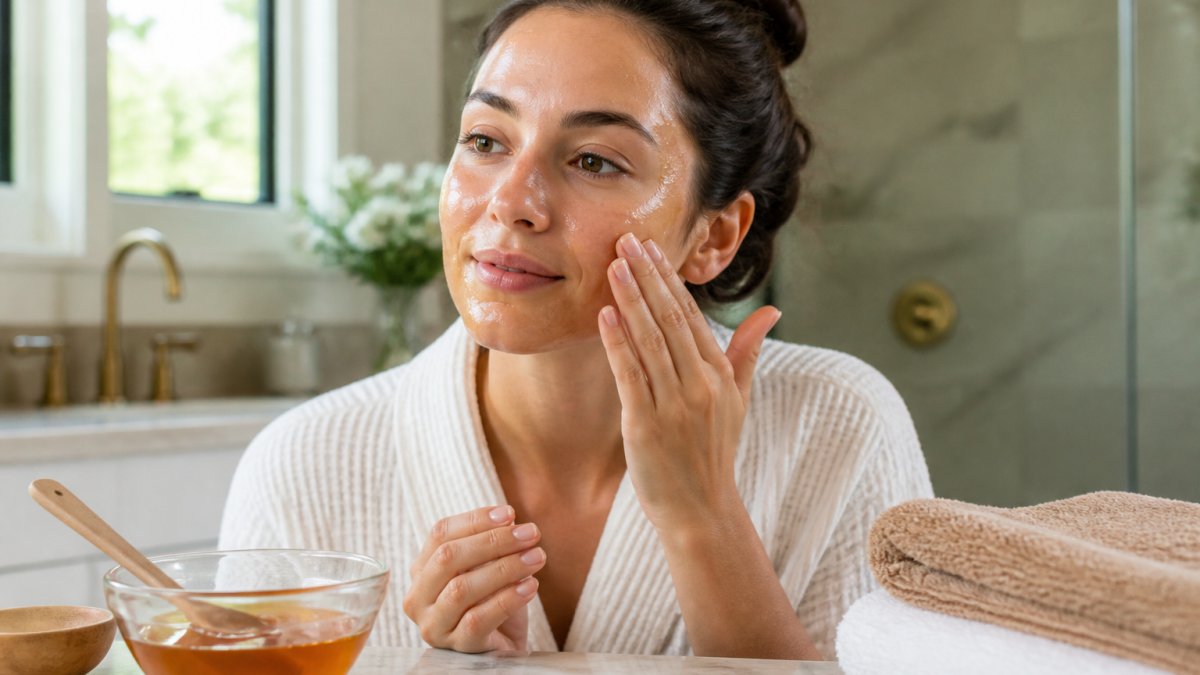
- Apply a thin layer with clean fingertips. Start at your cheeks and work outward. Skip the eye area.
- Leave it on for 10 to 15 minutes. More on timing below.
- Rinse with warm water. Use a soft washcloth to lift the honey without tugging.
- Pat dry and moisturize right away while skin is still damp.
Best Honey for Skincare: Raw, Manuka, or Grocery Store?
Raw honey hasn't been heavily heated or fine-filtered, so it typically retains pollen, trace enzymes, and antioxidants that processing can reduce.
Regular grocery-store honey is usually pasteurized and finely filtered.
Creamed honey is crystallized under controlled conditions, making it thick and spreadable so it doesn't run down your neck.
Here's how the main types compare:
| Honey Type | Best For | Relative Cost | What to Look For on the Label |
|---|---|---|---|
| Raw honey | Everyday hydration | Low | "Raw" or "unfiltered" |
| Manuka honey | Acne-prone or reactive skin | High | A UMF or MGO rating |
| Regular grocery honey | Budget option | Lowest | No special claim needed |
| Creamed honey | Easy spreading | Low | "Raw" if you want it unheated |
How to read a honey label. "Raw" and "unfiltered" matter most.
How to identify real raw honey
How Long to Leave Honey Mask on Face (and How to Rinse It Off)
Leave a honey mask on for 10 to 15 minutes, long enough for the humectant effect without letting the honey dry out and pull moisture back from your skin.
Very dry skin: start with 10 minutes. If it feels fine, extend to 20. Never leave it until it cracks and flakes, dry honey works against you.
Rinsing is where many people go wrong. Honey is sticky, so tugging at it irritates skin. Do this instead:
- Splash warm water over your face to loosen the honey
- Press a soft, damp washcloth against your skin for a few seconds
- Wipe gently downward, then rinse again
- Finish with cool water to calm the skin
- Pat dry and apply moisturizer within a minute
Does Honey Help with Acne? What Dry and Acne-Prone Skin Should Know
Honey can help mild acne thanks to its antibacterial and anti-inflammatory properties. It won't clear cystic acne, but it can calm redness and support healing for surface breakouts.
Dry and acne-prone skin need different care, a mask that hydrates beautifully may feel heavy on an oily T-zone. How to handle both:
- Dry cheeks, oily T-zone: Apply honey only to the dry areas. Keep it off your forehead and nose.
- Active breakouts: Use raw or manuka honey alone, without added oils.
- Sensitive skin: Patch test first. More on that below.
- Post-breakout marks: Honey's soothing properties may help calm the look of redness over time.
Honey is not a replacement for acne treatment. If breakouts are deep, painful, or widespread, see a dermatologist.
Carrier Oils, Yogurt, and Rosewater: Simple Honey Mask Variations
Plain honey works well, but one add-in can make it work better for your skin. Three simple variations:
Collagen & Snail Skincare Set-Complete Face & Body Kit (6-Piece Set) →
Honey and carrier oil (for very dry skin). Mix 1 tablespoon of honey with a few drops of jojoba or almond oil. Jojoba is close to your skin's own oils and absorbs well; almond oil is lighter and adds a soft finish.
Honey and rosewater (for sensitive skin). Combine 1 tablespoon of honey with 1 teaspoon of rosewater.
Honey and yogurt (for dull, uneven skin). Mix 1 tablespoon of honey with 1 tablespoon of plain yogurt. Yogurt's lactic acid gently supports exfoliation and pore cleansing.
For all three, follow the same steps: damp skin, thin layer, 10 to 15 minutes, warm water rinse, pat dry.
Troubleshooting, Storage, and Ingredient Quality
This is the part most honey-mask guides skip, and it decides whether the routine works for you. Reactions happen even with natural ingredients, and leftover mask has a shelf life.
Patch test before your first mask
Put a small dot of honey on your inner forearm and wait 24 hours. If you see redness, itching, or swelling, don't put it on your face. Repeat the test any time you add a new ingredient, since the reaction could be to the add-in rather than the honey.
If your skin stings, burns, or turns red
Rinse immediately with cool water, don't wait to see if it settles. Cool water calms skin and removes honey faster than warm water, which can drive irritation further. Skip all masks for about a week, then patch test your forearm again.
A mild tingle for the first 30 seconds is common and usually fades. Sharp stinging, heat, or visible redness that spreads is not, and it's your signal to stop.
What to do if the mask dries out and cracks
If the honey dries to flaking, it's pulling moisture back out of your skin. Rinse it off right away with warm water and a soft cloth. Next time, shorten to 10 minutes, or cover the thin layer with a warm, damp washcloth to keep it from setting.
Storage and shelf-life
How long a mask keeps depends on what's in it.
- Plain honey mask: Keeps at room temperature in a clean glass jar with a lid for several weeks. Honey is naturally low in water, so it resists spoilage.
- Honey plus a carrier oil: Keeps at room temperature about two weeks. Oils go rancid, so smell it before each use, a sharp or crayon-like odor means it's past its prime.
- Honey plus rosewater: Refrigerate and use within three to four days. The added water makes it far more perishable than plain honey.
- Honey plus yogurt: Refrigerate and use within two to three days. Yogurt is a live dairy product and spoils fastest of all the variations.
Make small batches, one or two masks' worth, so you're not throwing ingredients away. Label the jar with the mix date; masking tape and a marker are enough.
Ingredient quality
Buy honey from a source you trust and look for "raw" or "unfiltered." For carrier oils, cold-pressed means extracted without high heat, preserving more natural properties. For yogurt, plain and unsweetened beats flavored, flavored adds sugar and stabilizers that do nothing for your skin.
Handcrafted and small-batch products can vary from jar to jar, normal with natural ingredients. What matters is that the maker is transparent about what's inside and when it was made.
When you want the same benefits without mixing anything, FAITH & RICH offers a Collagen & Snail Essence Face Serum that hydrates and smooths skin for daily use. Pair it with the Collagen & Snail Body Lotion for full-body moisture.


Conclusion: Make Honey Masks Part of Your Routine
Dry skin rarely fixes itself with one product, it needs steady care, and a honey face mask is one of the simplest habits you can build. Two or three times a week, ten minutes each, is enough to see a difference.
If you'd rather skip the mixing, FAITH & RICH makes skincare that fits right into the same routine. Our Collagen & Snail Skincare Set hydrates and nourishes while promoting a more radiant look, and our Castro Oil adds deep moisture for skin that needs extra care. Both are built for the same goal: skin that feels soft, calm, and cared for.

EXPLORE the full FAITH & RICH collection and find the products that match your skin's needs.
Frequently Asked Questions
Can I apply raw honey on my face every day?
Daily use is usually fine for most skin types, but dry or sensitive skin often does better with two to three times a week. Start with a patch test on your inner arm, then apply a thin layer to your face and leave it on for 10 to 15 minutes. If your skin feels tight, itchy, or red afterward, space the masks further apart. Rotating a honey face mask with your regular moisturizer keeps the skin barrier balanced without overdoing exfoliation.
Which type of honey is best for face masks?
Raw, unprocessed honey is the best pick because it keeps more of the natural enzymes and antibacterial compounds that make honey useful for skin. Manuka honey is a strong option if you want higher antibacterial activity, while local raw wildflower honey works well for everyday hydration. Avoid heavily filtered or flavored syrups labeled as honey spreads, since they lack the humectant and emollient properties that make a honey face mask effective for dry skin.
How long should you leave a honey mask on your face?
Most people should leave a honey mask on for 10 to 20 minutes. Dry skin can go closer to 20 minutes for extra hydration, while sensitive skin should start at 10 minutes and build up. Set a timer so you do not leave it on too long, since honey can start to feel tacky and pull at the skin. Rinse with warm water and pat dry before applying moisturizer.
Does honey help with acne and dry skin simultaneously?
Yes, honey can support both concerns because it acts as a humectant that draws water into the skin while also offering mild antibacterial and anti-inflammatory properties. For acne-prone dry skin, mix raw honey with a small amount of plain yogurt or rosewater to keep the formula light. Always patch test first, and avoid adding heavy oils like coconut oil if you are breakout-prone. If acne is severe or cystic, see a dermatologist before relying on DIY masks alone.


