

Benefits of Organic Ingredients in Lip Care

Table of Contents
- Why Organic Lip Care Beats Conventional Formulas
- Natural Lip Balm Ingredients That Actually Work
- Ingredients for Dry Lips: What to Look For
- Organic Lip Balm for Sensitive Lips: Avoiding Irritants
- How to Choose the Best Organic Lip Balm
- The Limits of Ingredient Claims: What the Evidence Shows
- Conclusion
- Frequently Asked Questions
Last Updated: October 12, 2026
Why Organic Lip Care Beats Conventional Formulas
The benefits of organic ingredients in lip care start with a simple fact: your lips absorb what you put on them.
Organic lip care is the practice of choosing lip balms and treatments made with plant-derived ingredients grown without synthetic pesticides, rather than petroleum-derived occlusives and synthetic fillers. The difference shows up in how your lips feel after weeks of use, not just minutes.
The Problem With Petroleum-Based and Synthetic Balms
Petroleum jelly and mineral oil are the backbone of most drugstore balms. They seal the surface, which feels soothing at first. The trouble is that they add nothing back.
That doesn't make every conventional balm useless. It means the ingredient list matters more than the label's promises. A balm that only coats your lips treats the symptom. A balm that delivers fatty acids, vitamins, and waxes alongside the seal supports the skin barrier itself.
Natural Lip Balm Ingredients That Actually Work
The best natural lip balm ingredients fall into three functional groups: emollients, humectants, and occlusives. Understanding which does what turns label reading from guesswork into a quick decision.
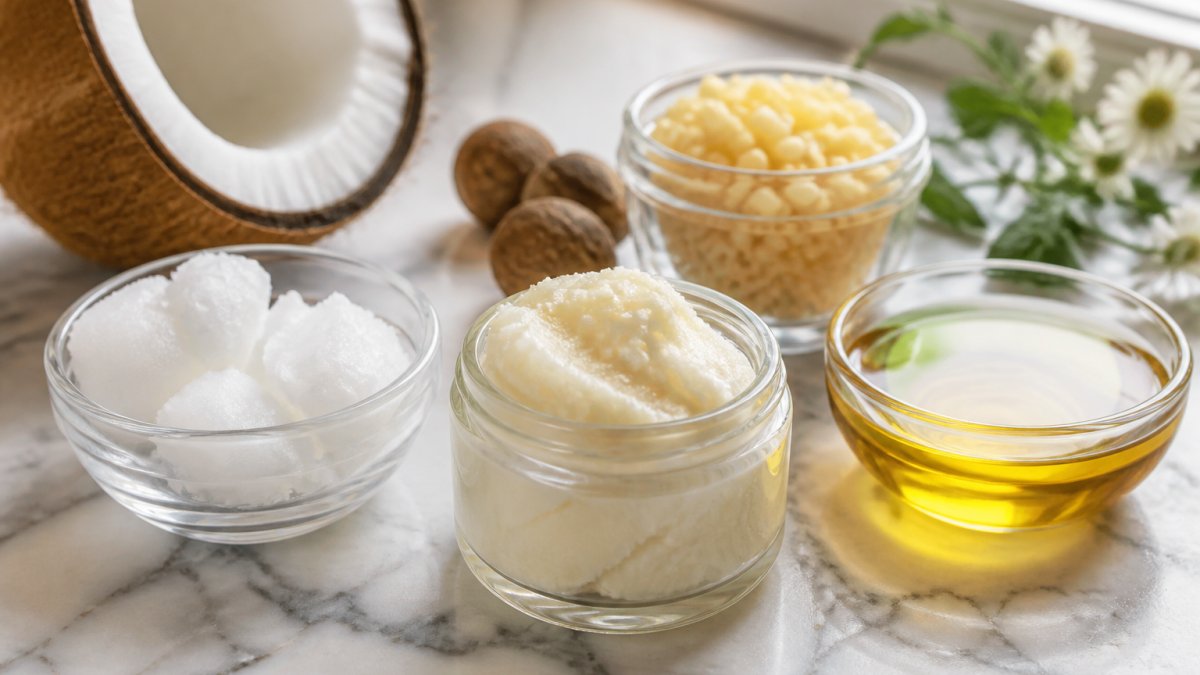
Emollients, Humectants, and Occlusives Explained
Emollients are ingredients that soften and smooth the surface of the lips by filling gaps between skin cells. Jojoba oil, coconut oil, and shea butter are classic emollients.
Humectants pull water into the skin. Aloe and glycerin are common examples.
Occlusive agents form the protective barrier that seals moisture in. Beeswax and plant-based waxes are the workhorses here. Cocoa butter does double duty as both emollient and occlusive.
A well-built balm uses all three. If a formula leans on humectants alone, you'll reapply constantly.
The Role of Antioxidants Like Vitamin E
Vitamin E, listed on labels as tocopherol, is a fat-soluble antioxidant. It helps defend lips against free radicals from sun exposure, wind, and pollution, and it slows the oxidation of the oils in the formula itself. That second job matters more than most people realize: a balm made with delicate plant oils can turn rancid without antioxidant support, which is why tocopherol shows up in well-formulated organic products.
Ingredients for Dry Lips: What to Look For
"Dry lips" is not one problem, and the ingredient that fixes one version can underperform on another. Persistent cracking, cold-weather tightness, and post-illness peeling respond to different combinations. Instead of a single ranked list, match the ingredient to the concern.
Match the Ingredient to the Concern
Persistent cracking and deep fissures. Prioritize occlusives that stay put: beeswax, candelilla wax, and cocoa butter.
Cold-weather and wind-driven dryness. Look for butters with a higher melting point, like shea and mango seed butter, plus jojoba oil.
Peeling after illness or dehydration. This is usually a humectant problem more than an occlusive one.
Sensitivity plus dryness. Skip fragrance, flavor oils, and essential oils entirely.
Vegan preference. Beeswax, lanolin, and honey are animal-derived.
Reading the Order of Ingredients
Ingredients are listed by concentration, so position matters more than presence. A balm that lists shea butter fourth is not the same product as one that lists it first. As a working rule:
- Occlusives and primary emollients should appear in the first three to five ingredients.
- Humectants should appear before any fragrance or flavor.
- Fragrance, flavor, and essential oils belong at the end, or nowhere, if your lips are reactive.
- An antioxidant such as tocopherol (vitamin E) should appear somewhere in the list to slow rancidity in delicate plant oils.
What to Avoid
Petroleum, mineral oil, and drying alcohols are the usual suspects, but the more useful filter is function. A balm that only coats treats the symptom. A balm that delivers fatty acids, vitamins, and waxes alongside the seal supports the barrier itself. If the first ingredient is a petroleum derivative and nothing else in the list adds nutrition, you are buying a seal, not a treatment.
Organic Lip Balm for Sensitive Lips: Avoiding Irritants
Sensitive lips react to specific ingredients, not to "natural" or "synthetic" as categories. An organic lip balm for sensitive lips is one with a short ingredient list and no known triggers, but "organic" and "hypoallergenic" are not the same claim, and certification does not test for reactivity.
Common Allergens in Natural Formulas
Plant-derived does not automatically mean gentle. Some of the most frequent contact allergens in lip products are botanicals:
- Flavor oils such as peppermint, citrus, cinnamon, and vanilla
- Lanolin, a wool-derived ingredient that some people react to
- Beeswax and propolis, generally well tolerated but occasionally problematic
- Essential oils used for scent, including lavender, tea tree, and peppermint
- Preservatives in water-containing formulas, such as parabens and formaldehyde releasers
- Balsam of Peru and cinnamates, fragrance compounds that show up in flavoring blends
A useful distinction: fragrance-free means no added scent compounds at all, while unscented can still contain masking fragrances. Essential-oil-free is a narrower claim than fragrance-free, a balm can be free of synthetic fragrance and still contain lavender or peppermint oil, which are common triggers.
Patch-Testing Before You Commit
A reaction can take hours or days to appear, so a single swipe on the wrist is not enough. A practical protocol:
- Apply a small amount to the inner forearm and leave it for 24 hours.
- If there is no reaction, apply a thin layer to one corner of the mouth and wait another 24 hours.
- Only then use it across the full lip area.
Most practitioners find that reactions to lip products show up within 48 to 72 hours of consistent use, so keep the test product separate and note the date you started it.
When to Stop Using a Product
Stop and discontinue use if you notice:
- Stinging, burning, or tingling that does not fade within a few minutes
- Peeling, flaking, or a rash that spreads beyond the lip line
- Swelling, blistering, or cracking at the corners of the mouth
- Symptoms that worsen with continued use rather than improving
If your lips sting, peel, or develop a rash shortly after applying a new product, stop using it and note the ingredients. A dermatologist or allergist can help identify the specific trigger through patch testing.
The Licking Loop
Flavored and scented balms can create a self-perpetuating cycle: the flavor encourages licking, saliva evaporates and dries the lips, and you reach for the balm again. A plain, unflavored formula breaks that loop. If you find yourself reapplying more than every couple of hours, the formula may be the problem rather than the solution.
How to Choose the Best Organic Lip Balm
The best organic lip balm for you depends on three things: your sensitivity level, your climate, and how the formula is certified. Start by reading the ingredient list from top to bottom, since ingredients are listed by concentration.
Organic vs. Natural vs. Certified Organic
These terms are not interchangeable, and the gap between them is where most shoppers get misled.
| Label Term | What It Means | What to Check |
|---|---|---|
| Natural | Ingredients are plant-derived or minimally processed; no legal definition | Full ingredient list; "natural" alone proves nothing |
| Organic (ingredient) | A specific ingredient was grown without synthetic pesticides | Which ingredients carry the claim, and at what percentage |
| Certified Organic | Third-party certifier verifies the formula against a published standard | The certifier's name and seal on the packaging |
Under USDA organic labeling standards, a product can only carry the "made with organic ingredients" claim if it meets defined thresholds for organic content. A balm can contain one organic ingredient and still be mostly synthetic filler. That's legal. It's also why the seal matters more than the word.
For a practical label-reading checklist:
- Are occlusives (beeswax, cocoa butter, shea butter) in the first five ingredients?
- Do emollients like jojoba or coconut oil appear before any fragrance?
- Is there a named certifier, or just the word "organic" in the marketing copy?
- Is the flavor or scent list short and free of your known triggers?
- Does the packaging list tocopherol or another antioxidant?
The Limits of Ingredient Claims: What the Evidence Shows
Honesty matters more in this category than in almost any other, because the claims run far ahead of the proof.

Ingredient percentage is the number most brands won't publish. A balm can list shea butter and still contain less than one percent of it.
The same caution applies to antioxidants. Vitamin E has a well-established role in protecting oils from going rancid, and it's a recognized antioxidant.
One more limit worth naming: organic certification covers farming and processing standards.
Conclusion
Reading a lip balm label well takes about thirty seconds, and it's the difference between a product that supports your skin barrier and one that just feels nice for an hour.
At FAITH & RICH, that's the approach behind our lip collection. Our lip glosses, including Coconut, Ruby Rose, and Glamorous, are built for all-day hydration with a non-sticky finish. Explore the full range and find the finish that fits your routine.


Frequently Asked Questions
What are the benefits of organic ingredients in lip care?
Organic ingredients in lip care offer several advantages. They typically avoid synthetic pesticides and fertilizers, reducing exposure to potential irritants. Many organic ingredients like shea butter, jojoba oil, and coconut oil provide superior hydration and moisture retention compared to petroleum-based alternatives. They also contain natural antioxidants like vitamin E that help protect lips from environmental damage. For those with sensitive skin, organic formulas are less likely to cause reactions because they skip synthetic fragrances, dyes, and preservatives found in conventional balms.
Are organic lip balms better for sensitive lips?
Organic lip balms can be better for sensitive lips because they typically exclude common irritants like synthetic fragrances, artificial colors, and certain preservatives. However, natural does not automatically mean non-irritating. Some people react to essential oils, beeswax, or botanical extracts even in organic formulas. If you have very sensitive lips, look for short ingredient lists and patch test new products. Organic lip balm for sensitive lips works best when it contains soothing ingredients like shea butter and avoids potential allergens like citrus or peppermint oils.
Which natural ingredients help moisturize dry lips?
The most effective ingredients for dry lips fall into three categories: humectants that draw moisture in (like honey and aloe), emollients that soften and smooth (like jojoba oil and shea butter), and occlusives that seal moisture in (like beeswax and cocoa butter). Combining all three types gives the best results. Coconut oil and vitamin E are also popular because they provide both moisturizing and antioxidant benefits. Look for formulas that list these ingredients near the top, which indicates higher concentrations.
Can organic lip balm protect lips from sun damage?
Most organic lip balms do not contain SPF unless specifically formulated with mineral sunscreens like zinc oxide or titanium dioxide. While ingredients like shea butter and vitamin E offer some antioxidant protection against free radicals, they are not a substitute for sun protection. If you spend extended time outdoors, choose an organic lip balm with broad-spectrum SPF 15 or higher, or apply a mineral sunscreen lip product over your balm. Reapply every two hours, especially after eating or drinking.
Choosing lip care shouldn't require a chemistry degree or a leap of faith. FAITH & RICH makes it simpler with hydrating, non-sticky lip glosses in shades that flatter every skin tone, formulated to keep lips soft and supple through the day. Explore the collection and find your shade.


