

Natural Alternatives to Chemical Anti-Aging Skincare

Table of Contents
- Why Switch to Natural Alternatives to Chemical Anti-Aging Skincare Products
- Natural Anti-Aging Ingredients That Actually Work
- The Benefits of Honey in Skincare for Aging Skin
- How to Build a Self Care Routine for Skin Without Harsh Chemicals
- Budget-Friendly DIY vs. Professional Formulations
- Long-Term Efficacy and Sustainability of Natural Anti-Aging Skincare
- Frequently Asked Questions
Last Updated: September 18, 2026
Why Switch to Natural Alternatives to Chemical Anti-Aging Skincare Products
A growing number of shoppers now read the back of every bottle before they buy it. That shift has pushed alternatives to chemical anti-aging skincare products from a niche interest into a mainstream routine. This guide from FAITH & RICH walks through the ingredients that hold up, the ones that don't, and how to build a routine without harsh actives.
Natural anti-aging skincare works by supporting the skin's own repair process instead of forcing rapid turnover with strong synthetics. The goal is steady improvement, not a two-week overhaul.
Here's what most guides get wrong: they treat "natural" and "effective" as opposites. They aren't. Below, we'll show you exactly how plant-derived actives, antioxidants, and humectants compare with their synthetic counterparts, and where each one genuinely wins.
Understanding the Science of Skin Aging
Skin aging happens through two paths that often get lumped together. Intrinsic aging is genetic and moves slowly. Extrinsic aging comes from sun exposure, pollution, and lifestyle, and it moves much faster.
Collagen and elastin production declines over time. Cell turnover slows. The skin barrier holds less water, so fine lines and wrinkles deepen and skin texture roughens.
The practical takeaway: any ingredient that supports collagen production, hydration, or the skin barrier is doing real anti-aging work, whether it was made in a lab or pressed from a seed.
Chemical vs. Natural Skincare: Key Differences
Chemical skincare relies on synthesized actives such as retinol, glycolic acid, and stabilized vitamin C derivatives. They are well studied and fast-acting.
Natural skincare draws on botanical extracts, plant oils, and humectants. The best of these carry genuine dermatological evidence behind them.
The honest comparison isn't "safe versus unsafe." It's speed versus tolerance. Synthetics often deliver visible change faster. Natural formulas tend to be gentler and better suited to reactive or sensitive skin.
| Approach | Typical Actives | Speed of Results | Best For |
|---|---|---|---|
| Synthetic | Retinol, glycolic acid | Faster, can irritate | Resilient, non-reactive skin |
| Natural | Bakuchiol, rosehip oil | Slower, steady | Sensitive or reactive skin |
| Hybrid | Niacinamide plus botanicals | Moderate | Most skin types |
Natural Anti-Aging Ingredients That Actually Work
The strongest natural anti-aging ingredients fall into three groups: plant-derived retinol alternatives, antioxidants, and hydration agents. Each targets a different part of the aging process.
Plant-Derived Retinol Alternatives: Bakuchiol and Rosehip Oil
Bakuchiol is the most studied retinol alternative. It supports cell turnover and collagen production with far less irritation than retinol, which makes it a practical option for anyone who has given up on retinoids.
Rosehip oil brings vitamin A precursors and vitamin E. It supports skin elasticity and helps soften the look of fine lines over consistent use.
Neither will match prescription-strength retinol for speed. For sensitive skin, that trade is usually worth it.
Antioxidant-Rich Botanical Extracts and Hydration Heroes
Antioxidants protect against the free radical damage that drives extrinsic aging. Botanical extracts, vitamin C, and vitamin E all fall here.
For hydration, look for hyaluronic acid, jojoba oil, and argan oil. These support the skin barrier and improve skin texture without stripping it.
The Benefits of Honey in Skincare for Aging Skin
Honey is one of the few natural ingredients with a long history of topical use and a clear mechanism. It is a humectant, so it pulls water into the skin, and it contains natural antioxidants that support the skin barrier.
For aging skin, that combination matters. Dryness exaggerates every fine line, so hydration alone visibly improves skin texture.
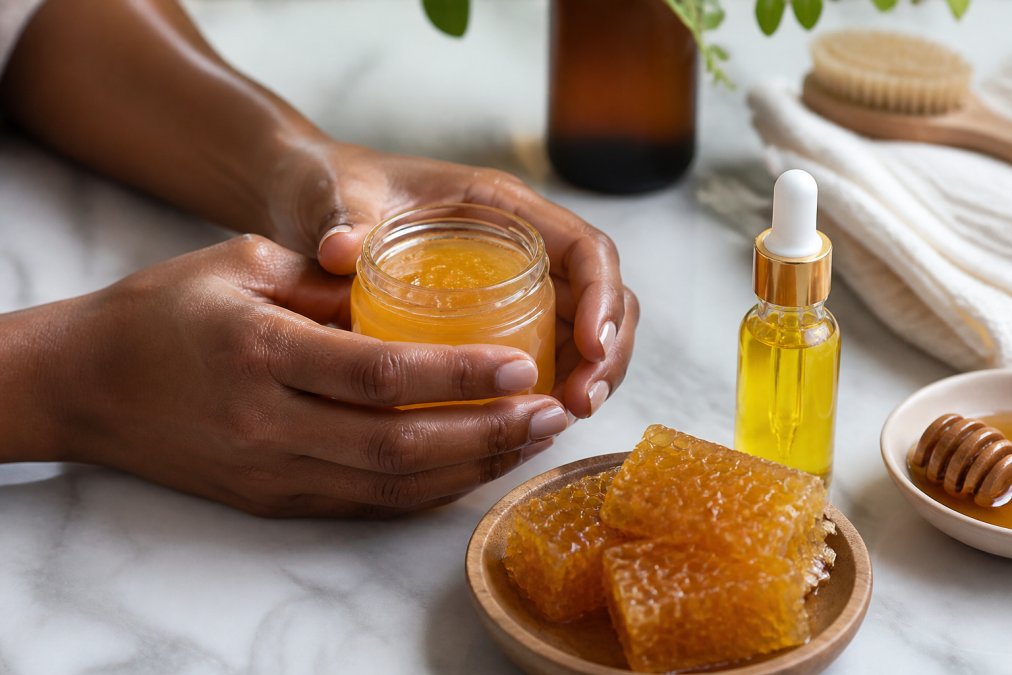
Honey-based cleansers and soaps suit mature or reactive skin because they clean without stripping. The American Academy of Dermatology's guidance on gentle cleansing notes that harsh cleansers damage the skin barrier, which is the opposite of what aging skin needs.
How to Build a Self Care Routine for Skin Without Harsh Chemicals
Knowing how to build a self care routine for skin starts with simplicity. Most people over-apply products and under-apply consistency. Four steps, done daily, beat ten steps done occasionally.
A Simple Morning and Evening Routine
Morning:
- Rinse with lukewarm water or a gentle cleanser
- Apply a vitamin C or botanical antioxidant serum
- Follow with a hydrating moisturizer
- Finish with broad-spectrum sunscreen
Evening:
- Cleanse to remove sunscreen and buildup
- Apply a bakuchiol or rosehip treatment
- Seal with a richer moisturizer or facial oil
That's it. No at-home peel needed every week, and no acid layering.
Patch Testing and Skin Sensitivity
Patch testing is the step almost everyone skips. Apply a small amount behind your ear or on your inner forearm. Wait 24 hours. If there's no reaction, test it on your jawline for another day before using it on your full face.
Introduce one new product at a time, spaced a week apart. If something irritates you, you'll know exactly what caused it.
Budget-Friendly DIY vs. Professional Formulations
DIY skincare appeals because it's cheap and transparent. The trade-off is real: homemade mixtures lack preservatives, so they spoil quickly, and it's hard to control concentration.
Professional formulations cost more, but they solve three problems DIY can't. They're stable, they're tested for safety, and every batch is consistent.
For anyone managing hyperpigmentation or uneven skin tone, consistency matters more than cost savings. A turmeric and lemon routine only works if the formula is the same every time you use it.
FAITH & RICH's Turmeric Serum and Turmeric Face Cleanser are built around that idea: turmeric for its antioxidant content, lemon for natural vitamin C, and a stable base that behaves the same on day one and day sixty.


Long-Term Efficacy and Sustainability of Natural Anti-Aging Skincare
Natural formulas show their value over months, not days. Bakuchiol and rosehip oil need consistent use before skin elasticity and texture change becomes visible.
Sustainability is the other half of this. Sourcing transparency matters because "botanical" says nothing about how a plant was grown or harvested. Look for brands that name their ingredients and explain where they come from.
That's where the FDA's guidance on cosmetic labeling helps. It explains what brands must disclose on a label, which makes it easier to spot vague marketing claims.
Cost is the fair objection. A set like FAITH & RICH's Turmeric & Lemon Set at $79.99 covers cleanser, treatment, and moisturizer in one purchase, which is often less than buying three separate products.

Switching away from harsh actives takes patience, and the first month rarely shows dramatic change. The payoff is a routine you can actually keep, especially if your skin is sensitive or reactive. FAITH & RICH builds handcrafted toners and honey-based formulas designed to support that slower, steadier approach, with products that enhance natural beauty, fight blemishes, and reduce signs of aging. Explore the collection and build a routine your skin can tolerate for the long run.
Frequently Asked Questions
What are effective natural alternatives to retinol for anti-aging skincare?
Bakuchiol, rosehip oil, and turmeric are popular natural alternatives to retinol. Bakuchiol is a plant-derived compound that supports cell turnover without the irritation often linked to retinol. Rosehip oil provides vitamin A precursors and fatty acids that help with skin texture and fine lines. Turmeric serum, like the one from FAITH & RICH, promotes healthy cell turnover and improves circulation. These ingredients can be gentler on the skin barrier while still supporting collagen production and dermal health.
Are there FDA-regulated standards for 'clean' beauty products?
The FDA does not have a legal definition for 'clean beauty' and does not regulate the term. The agency oversees cosmetics for safety but does not approve products or ingredients before they go to market, except for color additives. This means 'clean' and 'natural' claims are largely self-regulated. When choosing alternatives to chemical anti-aging skincare products, look for brands that provide full ingredient lists and are transparent about sourcing and formulation.
What are the benefits of honey in skincare for aging skin?
Honey is a humectant, meaning it draws moisture into the skin, which helps with hydration and plumpness. It also contains antioxidants and natural enzymes that can support the skin barrier and soothe inflammation. For aging skin, honey-based soaps and toners can cleanse without stripping natural oils, leaving skin soft and nourished. FAITH & RICH offers handcrafted honey-based soaps that fit into a natural anti-aging routine.
How can I build a natural anti-aging routine without harsh chemicals?
Start with a gentle cleanser like the Turmeric Face Cleanser from FAITH & RICH to remove impurities without stripping. Follow with an antioxidant-rich serum such as the Turmeric Serum or Collagen & Snail Essence Face Serum to support cell turnover and hydration. Moisturize with a natural face cream, and always patch test new products on your inner arm before applying to your face. Consistency matters more than intensity, so a simple morning and evening routine you can maintain will give the best long-term results.
How do plant-based antioxidants compare to synthetic anti-aging ingredients?
Plant-based antioxidants like vitamin C from lemon, curcumin from turmeric, and phytochemicals from botanical extracts can neutralize free radicals and support collagen production. Synthetic ingredients like glycolic acid and lactic acid can deliver faster exfoliation and cell turnover, but they may irritate sensitive skin. Natural alternatives often work more gradually and support the skin barrier. For those seeking non-irritating options, plant-based antioxidants offer a gentler path to improving skin texture and reducing fine lines.


